











Brecon High School © All rights reserved.
Cookies & Privacy Policy | Accessibility Statement | Terms of Use
Remote Access









ADMISSIONS
Admissions to Brecon High School is managed by Powys county Council, on behalf of the School. Details regarding school admissions can be found in the attached booklet. Further information, guidance and contact details can be found on the County Council website, the link is below
https://en.powys.gov.uk/article/1158/Apply-
If you wish to visit the school, please do make contact with us and we can arrange a time for a meeting and tour. Buddy days for pupils are also available.
ATTENDANCE & ABSENCES
If your child is going to be absent from School we need to know!
Please ensure the School is informed before 8.45am. You can let us know by telephone on 01874 620353 or via our email address
office@brecon-
If you do not inform us then the absence will be marked as unauthorised.
If you know in advance that your child is going to be absent then you can inform us at the School on 01874 620353, in writing or just let RECEPTION know the dates/times.
Medical/Dental appointments
Written or verbal information must be provided, otherwise the absence will be recorded as unauthorised.
Why attendance matters!
- Encouraging regular school attendance is one of the most powerful ways you can prepare your child for success—both in school and in life. When you make school attendance a priority, you help your child get better grades, develop healthy life habits and avoid dangerous behaviour.
- When pupils are absent for fewer days, their grades and reading skills often improve—even among those students who are struggling in school. Pupils who attend school regularly also feel more connected to their community and develop important social skills and friendships.
- As a parent, you can prepare your child for a lifetime of success by making regular school attendance a priority.
- The school has a duty to keep a record of the amount of Leave of Absence, both authorised and unauthorised, taken to monitor the extent of the issue and its effect on overall attendance levels. This could be published by the Governors in the report to parents, giving the absence figure excluding Leave of Absences during term time.
Please be aware that any unauthorised attendance will be investigated by the School Attendance Officer & Education Welfare Officer.
What constitutes good attendance?
Attendance percentages are not like examination results: an attendance percentage needs to be in the high nineties before it can be considered good. Consider the following examples over the course of a school year (188 days).
10 days absence = 95% attendance = 50 lessons missed
20 days absence = 89% attendance = 100 lessons missed
29 days absence = 85% attendance = 145 lessons missed
38 days absence = 80% attendance = 190 lessons missed
47 days absence = 75% attendance = 235 lessons missed
Research states that having 20 (89%) days off school every year means that a pupil will probably obtain a whole grade lower in their exams than they are really capable of.
Pupils with less than 85% attendance are unlikely to gain 5 A*-
Term-
Please read the below advice if you are considering requesting a leave of absence for your child(ren) in term time.
Only the HeadTeacher or their representative can authorise absence
- Each request will be considered on its merits, taking into account factors such as the child’s overall attendance record
- Permission will not be given for more than 10 days Leave of Absence in a school year, other than in exceptional circumstances
- Applications should be made at least 2 weeks in advance and arrangements for catching up on missed work agreed with the school. The school would not normally supply work for the pupils to complete during the Leave of Absence.
Leave of Absences taken without the permission of the school will be recorded as Unauthorised. An application for any leave of absence MUST be made on the request form at the bottom of the page.
Links & Downloads for more information about absence from School
Powys County Council guidance and information for parents about penalty notices and the code of conduct:
https://en.powys.gov.uk/article/1352/School-
School term dates:
https://en.powys.gov.uk/article/1166/School-
Download and complete this form (Or collect a copy from Reception) if you want to book time off during term time. Return back to the School BEFORE being absent from School:
DOWNLOAD HERE ………. REQUEST FOR BOOKING HOLIDAY IN BRECON HIGH SCHOOL DURING TERM TIME
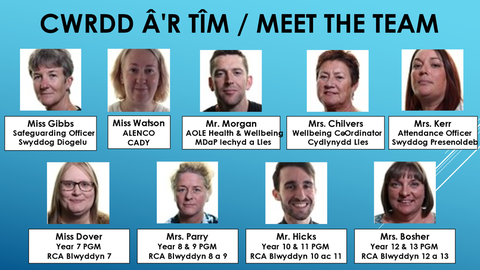
PASTORAL CARE
EXAMINATIONS
Click here for our desktop version of Exam Advice and Support
SCHOOL CALENDAR
Please note that some dates are not confirmed and subject to change. It is always advisable to telephone the School to check
SCHOOL DAY
SCHOOL MEALS
School Meal Pricing & Information
Parentpay
- Adding and using Parent Account Credit
- How to add a child to your account
- Cashless catering – biometric consent form
- Frequently Asked Questions
- How to pay for items
- Powys cashless catering privacy notice – English
- How to set-
up Email and Text Alerts
Pre-
We have had a number of enquiries from pre-
How to merge accounts for parents who have an existing login account in ParentPay from another school and would like to manage payments for their child/children at Brecon High School in the same account / email:
- Log into Parent Pay as normal, with their existing account
- Once logged in, om the left hand side select “Veiw Edit Profile;”
- Click add child to your account;
- In the activation Code 1/Username box, type the username provided by us;
- In the activation Code 2/Password box, type the password provided by us;
- Click search, select the child and click confirm.
Payers will now be able to see the relevant child/children in their normal ParentPay account alongside their existing list. They do not need to set up a second account in ParentPay with a different email address.
For any queries regarding ParentPay please sign post to: cashless.catering@powys.gov.uk

To apply for Free School Meals, please click on link below: English https://en.powys.gov.uk/article/11906/Free-
Welsh https://cy.powys.gov.uk/article/11909/Prydau-
Catering choices / sample menus, etc -
UNIFORM
Students are ambassadors of the school and are expected to dress and behave in a way that reflects the standards we seek to achieve. The uniform should be smart with all items clearly marked. If students are unable to wear the uniform for any reason the school must be notified in writing by the parents.

In the event of any disagreement regarding uniform, the Head and Deputy are the final arbiters.
|
|
|
|
|
|
|
|
|
|
|
|
|
|
|
|
|
|
|
|
|
|
|
|
RELIGION, VALUES AND ETHICS (RVE)
Religion, Values and Ethics (RVE) is a statutory element of the Curriculum for Wales for all learners up to the age of 16.
At the heart of the Curriculum for Wales are the Four Purposes, which set out aspirations for every learner. By the age of 16, they should be:
- Ambitious, capable learners, ready to learn throughout their lives
- Enterprising, creative contributors, ready to play a full part in life and work
- Ethical, informed citizens of Wales and the world
- Healthy, confident individuals, ready to lead fulfilling lives as valued members of society
The Role of RVE in Achieving the Four Purposes
RVE makes a distinctive contribution by providing opportunities for learners to:
- Explore ultimate and philosophical questions about life’s meaning, purpose, and the nature of human thought and the universe
- Engage with sources of wisdom and philosophy, considering human challenges and responses within their cynefin (local context), Wales, and the wider world
- Develop and express informed viewpoints, preparing them for lifelong learning in a diverse, pluralistic society
- Think critically about values and decision-
making, using knowledge of religious and non-religious worldviews - Understand historical and contemporary influences of religion and philosophy on human experience, enabling learners to imagine futures and create responsible solutions
- Evaluate evidence from diverse sources to address ethical and moral issues, fostering a sense of place, belonging, and cultural awareness
- Respond sensitively to beliefs and practices, understanding their impact on choices and actions locally and globally
- Establish secure values and ethical beliefs, supporting positive relationships built on trust and respect
- Reflect on personal and others’ perspectives, promoting mental, emotional, and spiritual well-
being through confidence, resilience, and empathy
Delivery of RVE
The Faculty of Humanities leads the delivery of RVE. However, many aspects are integrated across themes and subjects, contributing to the wider development of the new curriculum and school life.
Crefydd, Gwerthoedd ac Moeseg (CGM)
Mae Crefydd, Gwerthoedd ac Moeseg (CGM) yn elfen statudol o’r Cwricwlwm i Gymru ar gyfer pob dysgwr hyd at 16 oed.
Yn ganolog i’r Cwricwlwm i Gymru mae’r Pedwar Diben, sy’n nodi dyheadau ar gyfer pob dysgwr. Erbyn 16 oed, dylent fod yn:
- Dysgwyr uchelgeisiol, galluog, yn barod i ddysgu drwy gydol eu bywydau
- Cyfranwyr mentrus, creadigol, yn barod i chwarae rhan lawn mewn bywyd a gwaith
- Dinasyddion moesegol, gwybodus o Gymru a’r byd
- Unigolion iach, hyderus, yn barod i arwain bywydau boddhaus fel aelodau gwerthfawr o gymdeithas
Rol CGM wrth gyflawni’r Pedwar Diben
Mae CGM yn cyfrannu’n unigryw drwy gynnig cyfleoedd i ddysgwyr:
- Archwilio cwestiynau eithafol a ffilosoffaidd am ystyr bywyd, pwrpas, a natur meddwl dynol a’r bydysawd
- Ymgysylltu â ffynonellau doethineb a ffilosoffaeth, gan ystyried heriau dynol a’r ymatebion o fewn eu cynefin, Cymru a’r byd ehangach
- Datblygu a mynegi safbwyntiau gwybodus, gan eu paratoi ar gyfer dysgu gydol oes mewn cymdeithas amrywiol, lluosog
- Meddwl yn feirniadol am werthoedd a gwneud penderfyniadau, gan ddefnyddio gwybodaeth am safbwyntiau crefyddol ac anghrefyddol
- Deall dylanwadau hanesyddol a chyfoes crefydd a ffilosoffaeth ar brofiad dynol, gan alluogi dysgwyr i ddychmygu dyfodol a chreu atebion cyfrifol
- Gwerthuso tystiolaeth o ffynonellau amrywiol i fynd i’r afael â materion moesegol a moesol, gan feithrin ymdeimlad o le, perthyn a gwybodaeth ddiwylliannol
- Ymateb yn sensitif i gredoau ac arferion, gan ddeall eu heffaith ar ddewis a gweithredoedd yn lleol ac yn fyd-
eang - Sefydlu gwerthoedd a chredoau moesegol cadarn, gan gefnogi perthnasoedd cadarnhaol wedi’u hadeiladu ar ymddiriedaeth a pharch
- Myfyrio ar safbwyntiau personol ac eraill, gan hyrwyddo lles meddyliol, emosiynol ac ysbrydol drwy hyder, gwydnwch ac empathi
Darparu CGM
Mae’r Ffaglty Celfyddydau Dynol yn arwain ar ddarparu CGM. Fodd bynnag, mae llawer o agweddau wedi’u hintegreiddio ar draws themâu a phynciau, gan gyfrannu at ddatblygiad ehangach y cwricwlwm newydd a bywyd ysgol.
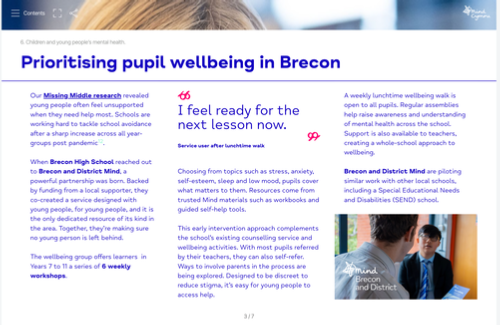
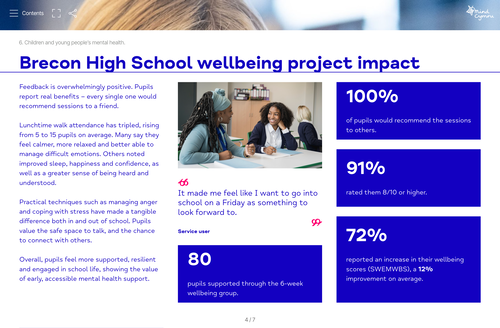 High School Wellbeing Project